Table of Contents
Yunnan Fossils: The Missing Piece in Complex Life’s Origin
For many years, biologists have struggled with a notable gap in the fossil record. The transition from the Ediacaran to the Cambrian period marked a vital moment in Earth’s history, yet the fossil collections from the Ediacaran show little connection to those from the Cambrian. This lack of overlap obscures the important time frame when various animal groups were evolving. On one side, we have the simple organisms of the Ediacaran, and on the other, the sudden emergence of recognizable animal life during the Cambrian explosion. Clearly, something crucial is absent — and no one has been able to uncover it.
The Hidden Controversy Behind the Yunnan Fossils Discovery
Most discussions overlook a crucial aspect of this issue. It wasn’t merely a gap in the rock layers; it represented a long-standing scientific debate. Molecular studies and trace fossils have indicated for years that animal lineages began to diversify well before the Cambrian explosion. However, fossils of many complex animal groups were notably absent from the Ediacaran period. DNA-based “molecular clocks” consistently suggested that animals were older than the geological evidence could confirm. For a long time, fossil hunters and geneticists were at odds with each other. The discovery in Yunnan provides the first solid physical evidence that supports the DNA findings.
The Yunnan Fossils Discovery, Explained
A team from Yunnan University, led by Professor Peiyun Cong and Associate Professor Fan Wei, has spent nearly a decade searching for various Ediacaran animal fossils. Collaborating with the Museum of Natural History at Oxford University, they published their findings in the journal Science on April 2, 2026. HR Katha
Interestingly, this site was nearly missed. While the rocks in Eastern Yunnan were known to contain fossils, they had only previously revealed algae remains, not animals. It took years of dedicated fieldwork for the team to uncover locations where animal fossils were found alongside the plentiful algae. Essentially, scientists had been overlooking this significant evidence for years, mistakenly believing it was just ancient seaweed.
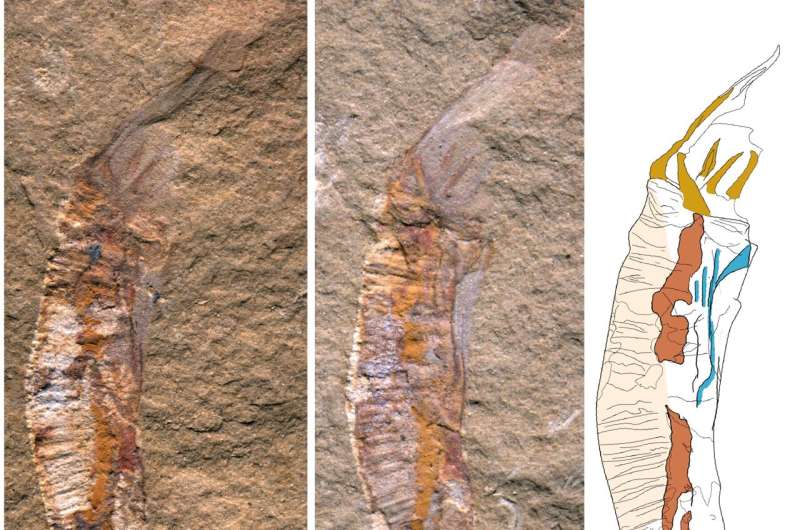
This site has managed to preserve what many others have failed to do. Unlike the majority of Ediacaran fossil sites that typically show organisms as impressions on sandstone, the fossils found in the Jiangchuan Biota are preserved as carbonaceous films. This method of preservation is more commonly associated with renowned Cambrian sites, such as the Burgess Shale in Canada. It’s this unique preservation style that allows this site to showcase anatomical features—like guts, feeding structures, and locomotor organs—that tend to decay and disappear in other locations.
A Transitional Community — and a Sandworm
Over 700 specimens have been found, dating back to approximately 554–539 million years ago, during the last phase of the Ediacaran period. These fossils feature the earliest known relatives of deuterostomes, which today encompass vertebrates such as humans and fish, as well as worm-like bilaterian creatures, early comb jellies, and ancient cnidarians that are related to jellyfish and corals. One specimen was so unusual that researchers turned to pop culture for a comparison — co-author Dr. Frances Dunn remarked that it bears a striking resemblance to the giant sandworms from Dune. Long before science fiction envisioned these monstrous worms, real ones were already making their way across the ocean floor, half a billion years ago.
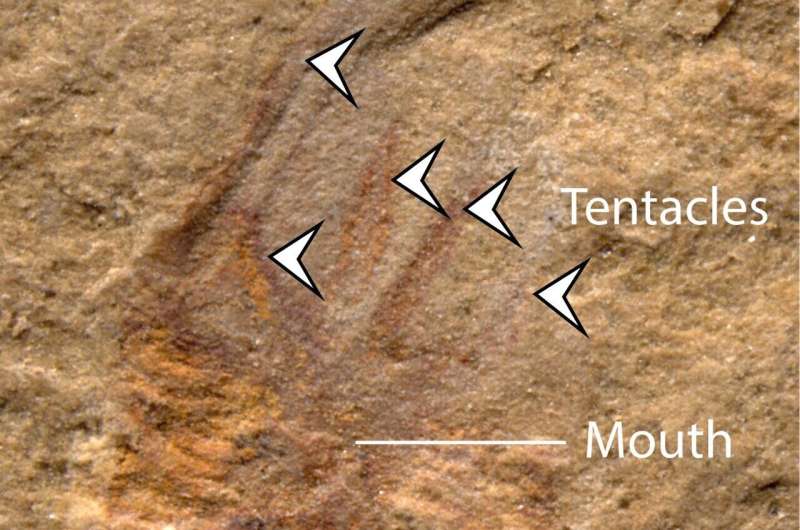
The discovery of ambulacrarians in the Ediacaran period suggests that chordates, or animals with backbones, were already present during that time. This finding is a significant revelation: our evolutionary lineage, which ultimately gave rise to vertebrates and humans, didn’t begin with the Cambrian explosion. Instead, it was already in progress around half a billion years ago, in a shallow sea that is now part of China.
How the Yunnan Fossils Connect Decades of Research
This discovery is part of a larger narrative. A study published in Science Advances in 2021 established a detailed radio-isotopic timeline for the biological changes during the Ediacaran period, providing the chronological framework that researchers needed to appreciate the importance of a transitional fauna dating back 554 to 539 million years. Additionally, a 2010 study in PLOS ONE initially suggested that tentacle-bearing Cambrian fossils found in Canada and China were early relatives of deuterostomes. The new fossils from Yunnan now offer direct evidence that supports this 16-year-old hypothesis with much older findings.
Why the Yunnan Fossils Discovery Matters
The significance of this study lies in its revelation that the rapid diversification of animal life occurred at least 4 million years earlier than previously thought, moving the timeline from the beginning of the Cambrian period to the conclusion of the Ediacaran. It also sheds light on the previously unexplained lack of evidence for these complex animal groups in various locations, suggesting that this absence may be due to differences in how well these organisms were preserved rather than indicating that they never existed.
Simple Ediacaran Life -> Jiangchuan Transitional Fauna (The Missing Piece) -> Complex Cambrian Animal Life
The blueprints that ultimately defined you were slowly developing in a shallow sea in China more than 500 million years ago. For decades, we overlooked the signs, confusing the beginning of our own narrative with mere algae.
Sources: Science Journal · Science Advances · PLOS ONE · University of Oxford · EurekAlert
Primary Study — Science (Li et al., 2026)
Open-Access Manuscript — Oxford Research Archive
University of Oxford — Official News Release
Supporting Paper — Science Advances (Yang et al., 2021)
https://www.ox.ac.uk/news/2022-11-02-500-million-year-old-fossils-reveal-answer-evolutionary-riddle